How Long Does Alcohol Stay in Your System? Full Guide
How long does alcohol stay in your system? On average, alcohol clears from your blood at about one standard drink per hour. It’s detectable in breath and saliva for up to 24 hours, in urine for 1–4 days depending on the test, and in hair for up to 90 days. The exact number for you depends on how much you drank, your body, and which test is being used.
That’s the short version but how long alcohol stays in your system is really three separate questions wearing one trench coat: how long until you’re no longer impaired, how long until your blood alcohol concentration (BAC) hits zero, and how long a test could still detect that you drank at all. Those three timelines don’t line up, and mixing them up is where most confusion and most bad decisions about driving, work, or breastfeeding comes from.
This guide walks through all three, using data from the National Institute on Alcohol Abuse and Alcoholism (NIAAA) and the Centers for Disease Control and Prevention (CDC), and shows you how to work out your own rough numbers instead of relying on a one-size-fits-all rule.
Note: this guide is written for general educational purposes and isn’t a substitute for medical advice. If you have concerns about your own drinking, a doctor or a service like SAMHSA’s National Helpline (1-800-662-4357) can help.
Table of Contents
How Your Body Actually Metabolizes Alcohol
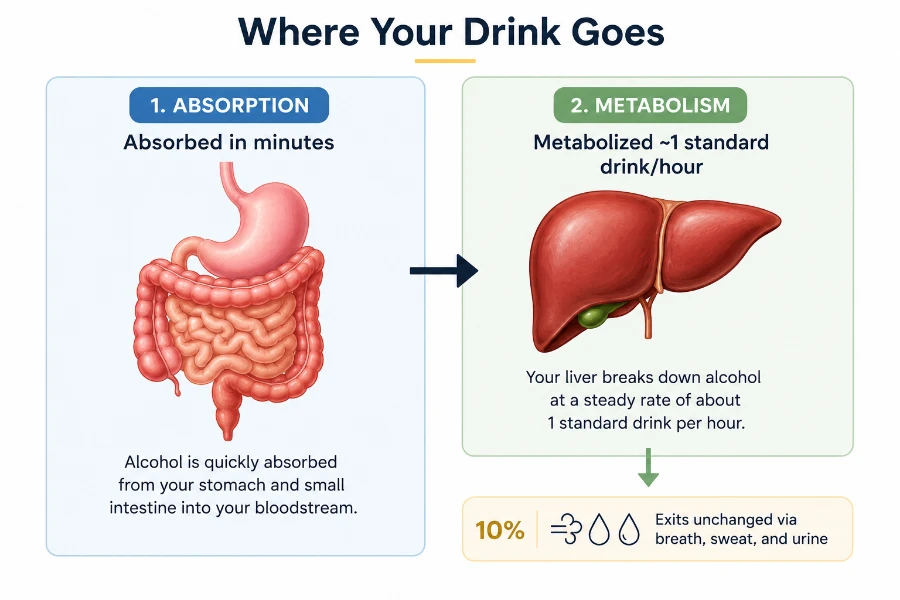
When you drink, alcohol is absorbed quickly through the stomach lining and small intestine and reaches your bloodstream within minutes. From there, it’s distributed through nearly all the water in your body’s tissues — which is why body composition matters so much (more on that below).
Metabolism itself happens almost entirely in the liver. Roughly 90% of ethanol is broken down there through a two-step enzymatic pathway: alcohol dehydrogenase (ADH) converts ethanol into acetaldehyde, and aldehyde dehydrogenase (ALDH) then converts that into acetate, which your body eventually clears as water and carbon dioxide. The remaining 10% or so leaves unchanged through breath, sweat, and urine — which is exactly why breath and urine tests work at all.
According to NIAAA, this process runs at a fairly fixed rate: about 0.015% BAC per hour, which works out to roughly one standard drink per hour for an average adult. A U.S. standard drink is defined as about 14 grams (0.6 fl oz) of pure alcohol — the amount in:
- 12 oz of regular beer (~5% ABV)
- 5 oz of wine (~12% ABV)
- 1.5 oz of distilled spirits like vodka or whiskey (~40% ABV)
That word “standard” is doing a lot of work here. Not every beer is 5%, and not every pour is a true 1.5 oz shot. A double IPA at 9% ABV or a generous restaurant pour of wine can easily count as 1.5–2 standard drinks even though it looks like “one.” If you want to know what you’re actually working with, our ABV Calculator converts any drink’s real alcohol content into standard-drink terms, so you’re estimating from accurate numbers instead of the size of the glass.
One important, research-backed point: nothing speeds this up. Coffee, cold showers, exercise, and drinking water don’t increase liver enzyme activity. They can make you feel more alert, but your BAC drops at exactly the same rate either way.
It’s also worth knowing that heavy, chronic drinking can change this picture. Over time, the liver can activate a secondary pathway (the microsomal ethanol-oxidizing system, involving the CYP2E1 enzyme) that increases alcohol clearance speed — but this comes at the cost of more oxidative stress on liver cells, which is part of why long-term heavy drinking damages the liver even as short-term “tolerance” seems to build.
Blood Alcohol Concentration: What the Numbers Actually Mean
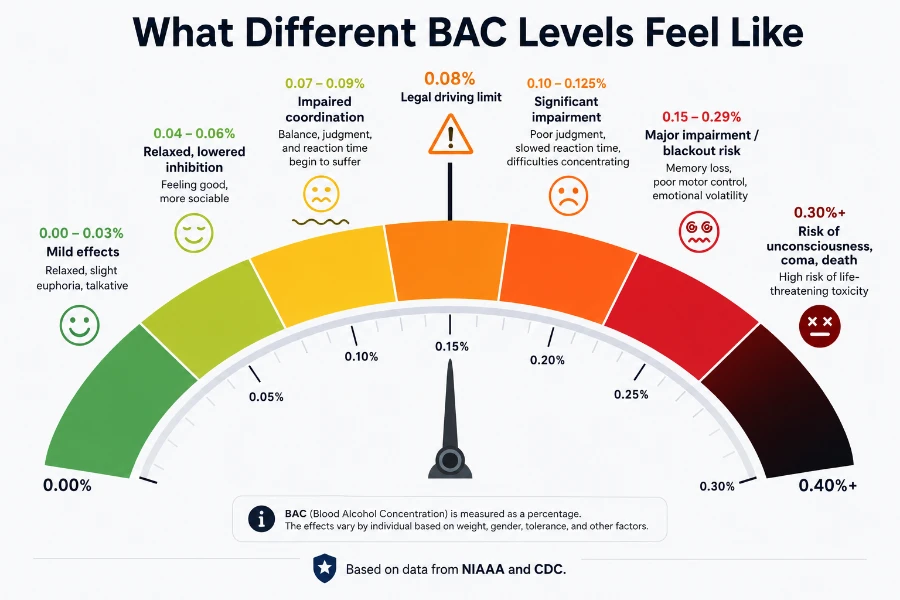
Since so much of this topic revolves around BAC, it helps to see what different levels actually feel like and how they’re classified. This chart reflects general ranges cited by NIAAA, CDC, and NHTSA research on alcohol-related impairment:
| BAC Level | Typical Effects |
|---|---|
| 0.02–0.03% | Mild euphoria, slight loss of shyness, no visible coordination loss |
| 0.04–0.06% | Relaxation, lowered inhibitions, minor impairment of reasoning and memory |
| 0.07–0.09% | Noticeable impairment of balance, speech, and reaction time; judgment reduced |
| 0.08% | Legal limit for driving in almost every U.S. state |
| 0.10–0.125% | Significant motor impairment, slurred speech, poor coordination |
| 0.15%+ | Major impairment across balance, judgment, and reaction time; risk of blackout |
| 0.30%+ | Risk of loss of consciousness |
| 0.40%+ | Risk of respiratory depression, coma, or death |
A binge-drinking episode defined by NIAAA as drinking that brings BAC to 0.08% or higher, typically 4+ drinks for women or 5+ for men within about two hours — can push someone well past the legal driving limit long before they “feel drunk” in an obvious way. That mismatch between how impaired you feel and how impaired you actually are is one of the most consistent findings in alcohol research.
How Long Does Alcohol Stay in Your System by Test Type?
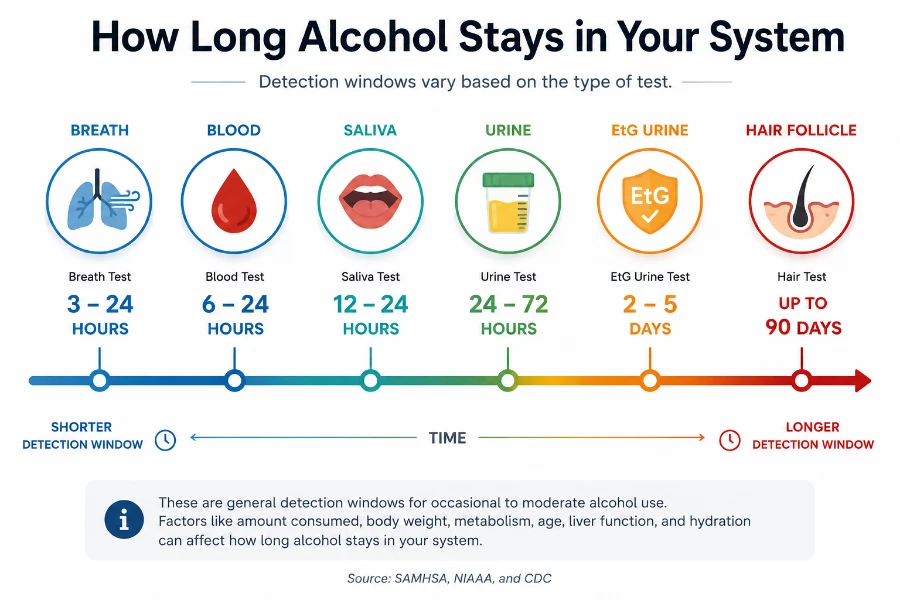
This is the part of the question that depends entirely on what’s being tested. Some tests detect alcohol itself; others detect metabolites that linger long after the alcohol is gone.
| Test Type | Typical Detection Window |
|---|---|
| Breath | 12–24 hours |
| Blood | 6–12 hours |
| Saliva | 12–24 hours |
| Urine (standard) | 12–24 hours |
| Urine (EtG, advanced) | Up to 72–80 hours |
| Hair follicle | Up to 90 days |
Blood tests measure BAC directly and have the shortest realistic window, since alcohol clears from blood fastest.
Breath tests (like a breathalyzer) estimate BAC from the alcohol in exhaled air and track closely with blood tests.
Urine tests vary a lot depending on which kind is used. A standard urine alcohol test typically only detects alcohol for under a day. An EtG (ethyl glucuronide) test, however, detects a metabolite that can be identified for up to three to four days which is why EtG testing is the standard in probation, workplace monitoring, and abstinence-based treatment programs, not casual testing.
Saliva tests sit in a similar range to blood and breath, generally around 12–24 hours.
Hair follicle tests work completely differently alcohol metabolites become incorporated into the hair shaft as it grows, so a single sample can reveal a drinking pattern going back roughly 90 days. This method is mostly used in legal, custody, or clinical monitoring contexts rather than everyday situations, since it reflects a pattern of use rather than a single incident.
Legal BAC Limits and Driving Safety
Per the CDC, most U.S. states set the legal driving limit at 0.08% BAC; Utah is the exception at 0.05%. But and this is the part that trips people up impairment starts well below the legal limit. Research using simulated driving tasks has found measurable declines in reaction time, lane control, and multitasking ability starting around 0.04–0.05% BAC, even though a driver at that level is technically still “legal” in most states.
This is why sleeping for a few hours, eating a meal, or feeling “fine” isn’t a reliable test of whether you’re under the limit. The only two things that actually lower BAC are time and your liver at the same roughly one-drink-per-hour pace discussed above.
If you want a clearer estimate than “just wait a while,” our BAC Calculator uses your drink count, ABV, weight, and time elapsed to give you a data-based estimate rather than a guess though it’s an estimate, not a substitute for simply not driving after drinking.
What Actually Changes Your Personal Timeline
The averages above assume a fairly typical adult under fairly typical conditions. In practice, several factors shift the timeline meaningfully:
Biological sex. Women generally have a higher average body-fat-to-water ratio and different enzyme activity levels than men, which often means a given amount of alcohol produces a higher BAC and a longer clearance time.
Body weight and composition. More total body water tends to dilute alcohol more effectively, while a higher body-fat percentage is associated with a higher peak BAC for the same intake, since alcohol distributes through water, not fat.
Food intake. Eating before or during drinking slows absorption and lowers your peak BAC it doesn’t change your liver’s clearance rate, but it changes how sharp that peak feels and how quickly you reach it.
Number and true strength of drinks. This is the most controllable variable, and also the one people misjudge most. Five standard drinks take roughly five hours to clear under average conditions but if what you’re drinking is stronger than a “standard” pour (double shots, high-ABV craft beer, fortified wine), your real intake is higher than your drink count suggests. Checking actual ABV with a Standard Drink Calculator is more accurate than counting glasses.
Liver health, medications, and genetics. Existing liver conditions, certain medications, and enzyme variants (such as ALDH2 deficiency, more common in some East Asian populations) can change how efficiently someone metabolizes alcohol, which is part of why two people who drink the same amount can have very different experiences and recovery times.
How to Estimate Your Own Timeline
You don’t need lab equipment to get a reasonable estimate of how long alcohol stays in your system the same logic used in clinical guidance can be applied at home:
- Count actual standard drinks, not glasses based on true ABV and pour size, not assumption.
- Multiply by roughly one hour per standard drink to estimate a rough blood-clearance window.
- Add a buffer. This is an average rate, not a guarantee, especially after heavy or fast drinking.
Example: Five standard drinks suggests a rough blood-clearance estimate of about five hours but that’s the blood alcohol timeline only. A urine EtG test or hair test could still detect that drinking happened well beyond that window.
This is exactly the estimate our BAC Calculator is built to handle enter your drinks, body weight, and time frame for a clearer, more personalized number than the flat “one drink, one hour” rule most articles stop at.
Alcohol, Breastfeeding, and Timing
This is a common real-world version of “how long does alcohol stay in my system,” and it deserves accurate treatment rather than outdated advice.
Per the CDC, alcohol enters and leaves breast milk at essentially the same rate as it enters and leaves the bloodstream — it isn’t “trapped” in breast milk separately. The general guidance is to wait about two hours per standard drink before nursing: roughly two hours after one drink, four to five hours after two, six to eight hours after three, and so on.
One persistent myth worth correcting: “pumping and dumping” does not remove alcohol from breast milk any faster. Since alcohol moves freely between blood and milk, the only thing that actually lowers the alcohol level in milk is the same thing that lowers BAC — time. Pumping and discarding can relieve physical discomfort or maintain supply, but it doesn’t speed up clearance.
Frequently Asked Questions
How long does it take for alcohol to fully be out of your body?
This is essentially the core of how long does alcohol stay in your system: for blood alcohol specifically, most people reach zero within 6–12 hours after their last drink, based on the roughly one-drink-per-hour clearance rate. Metabolites can still be detected far longer, though — up to 3–4 days in an EtG urine test, and up to 90 days in a hair follicle test.
Does drinking water flush out alcohol?
No. Water helps with hydration and can ease some hangover symptoms, but it has no effect on how fast your liver metabolizes alcohol. BAC declines at the same rate regardless of how much water you drink alongside it.
Can you still be drunk after 7 hours?
Yes, if the amount consumed was high enough. Heavy or fast drinking can produce a BAC that takes well beyond seven hours to reach zero, especially if drinking continued late into the night and true clearance time started later than assumed.
Is 12 hours enough to clear alcohol?
For light-to-moderate drinking (roughly 2–4 standard drinks), 12 hours is typically enough for blood alcohol to reach zero. For heavier sessions, it may not be — which is exactly why “I slept for X hours” isn’t a reliable proxy for being under the legal limit.
What is the 20-minute rule for alcohol?
It refers to the roughly 20–30 minutes it usually takes for a drink to be absorbed and start producing noticeable effects. It’s often cited as a reason to pace drinks and wait before deciding whether to have another, since a drink’s full effect isn’t felt the moment it’s consumed.
What do 7 days of no alcohol do?
A week of abstinence can improve sleep quality and hydration and give the liver a break from continuous alcohol processing. Many people notice better mental clarity within days, though larger effects like measurable liver enzyme improvement or fat loss generally take longer than a week to show up.
How many alcohol-free days help cleanse the liver?
The liver can begin repairing itself within days of stopping alcohol, but meaningful recovery particularly for anyone who has been drinking heavily — is generally measured in weeks to months, not days. Consistency over time matters more than any single short “detox” window.
Will I lose belly fat if I stop drinking alcohol?
Alcohol is calorie-dense with no nutritional value, so removing it often lowers total calorie intake, which can support fat loss over time, including around the midsection. It isn’t an isolated or guaranteed effect on its own overall diet and activity level still drive the outcome.
What happens 100 days without alcohol?
Around the 90–100 day mark, many people report more stable energy, better sleep, improved skin, and healthier liver enzyme levels. Notably, this is roughly the same window a hair follicle test can look back on a useful reminder that the body keeps a longer record of drinking habits than most people expect.
The Bottom Line
So ,how long does alcohol stay in your system? For blood, usually 6–12 hours. For breath and saliva, around a day. For urine, anywhere from a day to several days depending on the test used. For hair, up to three months. The exact number always comes back to the same variables: how much you drank, what you actually drank (not just how many “drinks”), your body, and which test is in play.
If you want a number based on your own drinks instead of a national average, our ABV Calculator shows you the real strength of what you’re drinking, and our BAC Calculator turns that into a personalized clearance estimate.
